For the past three years, mechanistic interpretability has largely treated a language model's native coordinates as the wrong level of description, training sparse autoencoders (SAEs) and transcoders to recover cleaner directions from superposed activations. Two November 2026 studies revisit that premise from complementary angles (T6). In a two-part Anthropic Fellows series (Part 1, Part 2), Jasmine Shone and Lisa Dunlap examine 3.4 million MLP neurons across four open-weight models (Llama-3.1-8B-Instruct, Qwen3-8B, Qwen3-14B, and OLMo-3-32B) by reading what each neuron writes into the residual stream rather than inspecting only the inputs on which it fires. Independently, Andrea Gregor de Varda, Ferdinando D'Elia, Greta Tuckute, Evelina Fedorenko, and Meenakshi Khosla (arXiv:2611.26920, covered in R9) test the coordinate axes of the residual stream itself across 12 language models from six architecture families against geometry-preserving random rotations.
Together, the two studies separate claims that have often been conflated. Individual MLP neurons rarely write two unrelated concepts under the same activation sign (0.4–1.1% of sampled middle-layer poles), their output vectors retain roughly the same vocabulary effect across depth, and zero-shot sets of native output vectors match or beat trained SAE dictionaries on concept detection, behavioral steering, LoRA weight auditing, and unlearning diagnostics—without auxiliary dictionary training. At the same time, native residual-stream coordinates sit strictly between random rotations and optimal orthogonal rotations (Random < Native ≪ Optimal), explaining why raw coordinates provide a strong, training-free baseline while leaving substantial distributed structure to multi-neuron subspaces and supervised probes.
1. Background: residual streams, SwiGLU neurons, lenses, and dictionaries
Interpreting claims about "the neuron basis" requires distinguishing two coordinate spaces inside a modern Transformer—and separating a neuron's scalar activation from its vector output.
Two coordinate spaces: residual stream vs. MLP layer
At token position $t$ and layer $\ell \in \{1,\dots,L\}$, a pre-norm Transformer maintains a residual stream vector $x^{(\ell)} \in \mathbb{R}^{d_{\text{model}}}$ (for example, $d_{\text{model}} = 4{,}096$ in Llama-3.1-8B). Attention heads and multilayer perceptron (MLP) blocks read from $x^{(\ell)}$ via root-mean-square normalization ($\tilde{x} = \operatorname{RMSNorm}(x^{(\ell)})$) and add their outputs back to the same vector:
Because sublayers communicate additively through $x^{(\ell)}$, the residual stream has no elementwise activation nonlinearity of its own. If subsequent layers read $x^{(\ell)}$ only through unconstrained linear projections, replacing $x^{(\ell)}$ by $Q^\top x^{(\ell)}$ for an orthogonal matrix $Q \in \mathrm{SO}(d_{\text{model}})$ and absorbing $Q$ into the surrounding weight matrices leaves the network function unchanged; only RMSNorm's per-coordinate gain vector and coordinate-wise optimizers such as Adam break full rotational symmetry. By contrast, inside each MLP block the hidden state lives in a wider space $\mathbb{R}^{d_{\text{mlp}}}$ (typically $d_{\text{mlp}} \approx 2.7\text{–}4\,d_{\text{model}}$, or $14{,}336$ per layer in Llama-3.1-8B), where an elementwise nonlinearity acts on each coordinate individually and privileges those coordinates by construction. Shone and Dunlap (Part 1, Part 2) study this $d_{\text{mlp}}$-dimensional MLP neuron basis; de Varda et al. (arXiv:2611.26920) test the $d_{\text{model}}$-dimensional residual-stream coordinate basis (including in Mamba state-space models).
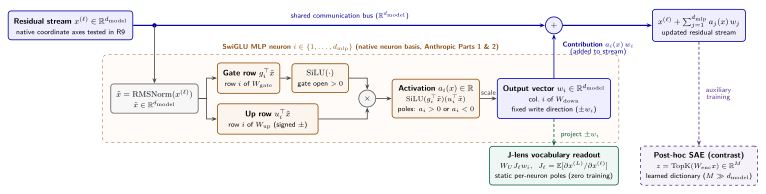
$i$ at layer $\ell$. Input weights ($g_i, u_i$) determine when and with what sign the scalar activation $a_i(x)$ fires; the fixed column $w_i$ of $W_{\text{down}}$ determines what direction is added to the $d_{\text{model}}$-dimensional residual stream. Shone and Dunlap read $\pm w_i$ statically via the Jacobian-corrected J-lens rather than training a post-hoc sparse autoencoder on activations.Input weights, signed activations, output vectors, and contributions
Older Transformers (GPT-2, OPT) used a two-matrix MLP $\operatorname{MLP}(\tilde{x}) = W_{\text{down}}\,\sigma(W_{\text{up}}\tilde{x})$, which Geva et al. 2021 (arXiv:2012.14913) interpreted as a key-value memory: row $i$ of $W_{\text{up}}$ acts as a key pattern over the input, and column $i$ of $W_{\text{down}}$ acts as the value vector written when that key matches. Modern open-weight LLMs (Llama 3, Qwen 3, Gemma 3, OLMo 3) replace the single input projection with a gated SwiGLU layer (Shazeer 2020, arXiv:2002.05202) parameterized by three matrices $W_{\text{gate}}, W_{\text{up}} \in \mathbb{R}^{d_{\text{mlp}} \times d_{\text{model}}}$ and $W_{\text{down}} \in \mathbb{R}^{d_{\text{model}} \times d_{\text{mlp}}}$:
where $\odot$ is elementwise multiplication and $\operatorname{SiLU}(z) = z / (1 + e^{-z})$. Writing $g_i^\top$ and $u_i^\top$ for row $i$ of $W_{\text{gate}}$ and $W_{\text{up}}$, and $w_i \in \mathbb{R}^{d_{\text{model}}}$ for column $i$ of $W_{\text{down}}$, four distinct quantities attach to neuron $i$:
- Input weights (
$g_i, u_i \in \mathbb{R}^{d_{\text{model}}}$): The gate row$g_i$controls whether the gate opens ($g_i^\top \tilde{x} > 0$), while the up-projection row$u_i$supplies a linear readout$u_i^\top \tilde{x}$that can take either sign. - Activation (
$a_i(x) \in \mathbb{R}$): The scalar$a_i(x) = \operatorname{SiLU}(g_i^\top \tilde{x})\,(u_i^\top \tilde{x})$computed on a specific token$x$. Unlike ReLU neurons ($a_i \ge 0$), a SwiGLU activation is signed: when the gate is open,$a_i(x) > 0$if$u_i^\top \tilde{x} > 0$and$a_i(x) < 0$if$u_i^\top \tilde{x} < 0$. Because$\operatorname{SiLU}(z)$dips slightly negative ($\min_z \operatorname{SiLU}(z) \approx -0.28$) when$z < 0$, a closed gate leaks small opposite-sign values; Shone and Dunlap therefore count a sign ("pole") as active only when it occurs with$g_i^\top \tilde{x} > 0$. - Output vector (
$w_i \in \mathbb{R}^{d_{\text{model}}}$): Column$i$of$W_{\text{down}}$, a fixed parameter vector independent of the current prompt. - Neuron contribution (
$a_i(x)\,w_i \in \mathbb{R}^{d_{\text{model}}}$): The vector actually added to the residual stream on token$x$. Because$w_i$is fixed, neuron$i$can only push the residual stream along$+w_i$(when$a_i(x) > 0$) or$-w_i$(when$a_i(x) < 0$), scaled by$|a_i(x)|$. Each neuron is a context-gated steering vector with at most two opposite poles.
Reading output vectors: logit lens vs. J-lens and J-share
At the final layer $L$, next-token log-probabilities come from applying final RMSNorm and multiplying by the unembedding matrix $W_U \in \mathbb{R}^{|\mathcal{V}| \times d_{\text{model}}}$. Early work (Geva et al. 2022, arXiv:2203.14680) read an intermediate output vector $w_i$ directly via the logit lens $W_U w_i$, asking which vocabulary tokens have largest dot product with $w_i$. In early and middle layers, however, $w_i$ does not act on $W_U$ directly; it passes through all remaining attention and MLP blocks from layer $\ell+1$ to $L$ (Belrose et al. 2023, arXiv:2303.08112).
To account for downstream processing without training per-layer probes from scratch for every neuron, Shone and Dunlap adopt the J-lens introduced by Gurnee et al. 2026 (arXiv:2607.15495). Let
denote the Jacobian of the final-layer residual stream with respect to the layer-$\ell$ residual stream, averaged over a calibration corpus. To first order, adding a small perturbation $\delta$ at layer $\ell$ shifts the final logits by $W_U J_\ell \delta$. The J-lens assigns each vocabulary token $v \in \mathcal{V}$ at layer $\ell$ the unit direction $d_{\ell,v} \in \mathbb{R}^{d_{\text{model}}}$ proportional to row $v$ of $W_U J_\ell$, and reads out each pole $\pm w_i$ by ranking tokens according to $\cos(\pm w_i, d_{\ell,v})$.
Not every residual direction maps onto vocabulary tokens: some neurons configure downstream attention heads rather than promoting words. Letting $\hat{w}_i = w_i / \|w_i\|_2$ and letting $v^*$ be the closest approximation to $\hat{w}_i$ formed by a nonnegative linear combination of at most 25 J-lens token directions, Gurnee et al. define the neuron's J-share as the explained variance
benchmarked against 2,048 random unit vectors in the same layer (high above the 99th random percentile, low below the 1st).
Why the field moved away from neurons: three objections and SAEs
Between 2022 and 2024, three empirical and theoretical arguments shifted interpretability toward sparse autoencoders (Cunningham et al. 2023, arXiv:2309.08600), which train an overcomplete encoder $z = \operatorname{TopK}(W_{\text{enc}} x + b_{\text{enc}}) \in \mathbb{R}^M$ and decoder $\hat{x} = W_{\text{dec}} z + b_{\text{dec}}$ with $M \gg d$ to decompose activations into sparse dictionary latents:
- Superposition and polysemanticity: In toy models where sparse features outnumber dimensions, networks pack more features than neurons into nearly orthogonal directions (Elhage et al. 2022, arXiv:2209.10652), and inspecting top-activating text passages of real MLP neurons frequently turned up unrelated topics.
- Cross-layer basis drift: Direct unembedding projections (
$W_U w_i$) are legible near the output layer yet noisy in early and middle layers, suggesting that intermediate layers write in layer-specific coordinate systems rotated or erased by later blocks. - Distributed computation: Causal tracing and rank-one model editing such as ROME (Meng et al. 2022, arXiv:2202.05262) showed that ablating individual neurons rarely changes factual predictions, implying that concepts and facts are spread across large coalitions of units.
2. Output vectors revisit the three objections to MLP neurons
In Part 1, Shone and Dunlap test each of the three objections across all 3.4 million MLP neurons of Llama-3.1-8B-Instruct, Qwen3-8B, Qwen3-14B, and OLMo-3-32B.
Verbalizability census and attention-routing neurons
Across the four models, 19–29% of MLP neurons have high J-share (above the 99th percentile of random directions in their layer), 56–81% fall in the middle range, and 1–21% fall below the 1st random percentile. When a blind Claude judge tests whether a neuron's J-lens token readout matches the common theme of its top-activating Pile passages, agreement reaches 73% on high-J-share neurons, 31% on middle-J-share neurons, and 19% on low-J-share neurons, against 4–6% for shuffled controls.
Crucially, low J-share does not imply uninterpretable noise. Measuring alignment between each output vector $w_i$ and the RMSNorm-folded query matrices $W_Q$ of downstream attention heads, 53–76% of low-J-share neurons exceed the 99th random percentile for query alignment (compared with 23–36% across all neurons). Rather than pushing vocabulary tokens directly, these neurons write structural routing signals—marking sentence boundaries, code blocks, or syntactic slots—that steer where later attention heads attend.
Objection 1: Output-aware polysemanticity and the rarity of Type 3 neurons
Almost all classic demonstrations of neuron polysemanticity were input-side: researchers gathered the passages maximizing $a_i(x)$ and observed unrelated topics. Once $a_i(x)$ and $\pm w_i$ are examined together, apparent polysemanticity splits into three mechanistically distinct cases (Figure 2a):
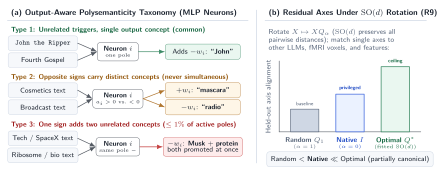
0.4–1.1% of sampled middle-layer poles). (b) Coordinate-rotation test on residual-stream representations from de Varda et al. (arXiv:2611.26920, R9), establishing Random < Native ≪ Optimal across cross-model, human fMRI, and linguistic benchmarks.- Type 1 (diverse input triggers, one output concept): Unrelated input contexts open the gate with the same sign because both call for the same downstream token or concept. In
Llama-3.1-8B-Instruct, neuronL28 n2760 (−)fires strongly on cybersecurity passages about the password cracker John the Ripper and on biblical commentary about the Fourth Gospel; in both contexts$-w_i$promotes the token"John", a connection that automated input-only labeling missed. - Type 2 (antipodal sign-multiplexing): Positive and negative activations (
$+w_i$vs.$-w_i$) write two unrelated concepts—for instance"mascara"when$a_i > 0$and"radio"when$a_i < 0$. Because$a_i(x)$has a single scalar value per token, the two concepts are never promoted simultaneously, and downstream heads reading$+w_i$with a threshold ignore$-w_i$. - Type 3 (same-pole superposition): A single active sign (
$+w_i$or$-w_i$) promotes two genuinely unrelated concepts at once, so firing on topic A also pushes topic B's vocabulary upward.
To measure how often Type 3 occurs in practice, Shone and Dunlap require a candidate pole to pass four causal checks: strong gate-open activation on both topics, single-neuron ablation on topic A lowering topic B's target tokens by at least $0.03$ nats and at least $3\sigma$ more than norm-matched random directions (and vice versa), specificity to that concept pair rather than a shared super-category, and whole-word promotion rather than shared subword spelling. Calibrated on synthetic superposed directions (where the pipeline achieves 62–81% recall), random samples of roughly 1,000 active middle-layer poles per model yield a recall-corrected Type 3 prevalence of 0.4–1.1% ($\le 1\%$). Targeted screening across all 3.4 million neurons still turns up 35 genuine Type 3 examples—such as Llama-3.1-8B L20 n2287 (−) jointly promoting Elon Musk and ribosomal protein translation, or Qwen3-8B L25 n5728 (−) pairing Singapore with Flutter—confirming that output superposition exists, while showing it is the exception rather than the norm among strongly active middle-layer poles. As the authors note alongside concurrent discussion between Nick Cammarata and Leo Gao over weak activations, low-magnitude firings still scale the exact same output vector $w_i$, though coalitions of weak firings could still cancel off-target components in aggregate.
Objection 2: An approximately fixed write basis across depth
If intermediate layers continually rotated features into new coordinate systems, an output vector $w_i$ from layer 8 should produce gibberish if added at layer 22. Computing singular values of linearized MLP maps $I + \partial \operatorname{MLP}^{(\ell)}/\partial x^{(\ell)}$ on Pile documents, Shone and Dunlap find that a middle-layer MLP shrinks ($\sigma < 0.1$) a median of 0–1 directions per layer—almost entirely formatting, boilerplate, or token-position markers rather than semantic concepts.
They then run a direct cross-layer transplantation test across 141 to 1,254 single-token WordNet nouns per model. Taking either a direct neuron for a noun (whose $w_i$ ranks the noun in the top 6 of raw $W_U w_i$) or an indirect early/middle-layer neuron (outside the top 500 in $W_U w_i$, yet top 10 under the J-lens $W_U J_\ell w_i$), they add $w_i$ into the residual stream at every other layer $\ell'$ before the final 10% of depth. Transplanted $w_i$ raises the target noun's final logit more than norm-matched random vectors in 93.0–99.6% of (concept, layer) pairs for direct neurons and 90.4–97.5% for indirect neurons. Rather than rotating a concept's direction from layer to layer, successive layers write nearly orthogonal facets of the same concept (mean pairwise $|\cos| = 0.019\text{–}0.043$ vs. $0.011\text{–}0.013$ for random vectors—for example, separate neurons for "moon" promoting its word form, night, crescent shape, spaceflight, and sky), which explains why skipping or swapping middle Transformer blocks degrades predictions gradually rather than catastrophically.
Objection 3: Distributed yet neuron-legible factual recall
Why, then, does ablating a single neuron almost never flip a factual completion? Tracing 18 factual prompts in Llama-3.1-8B-Instruct (athlete sports, novel authors, capital cities, chemical symbols, and Python package import names such as opencv-python $\to$ cv2 and pymupdf $\to$ fitz), Shone and Dunlap show that recall combines two readable pathways:
- One-hop direct answer writers: Roughly
8–16neurons whose J-lens readouts directly promote the answer token ("hockey","cv2","fitz"). Resample-ablating all direct answer writers at once leaves the model's top-1 answer unchanged on 15 of the 18 facts. - Multi-hop attribute and correlate writers: Dozens to hundreds of readable neurons writing partial attributes of the entity (for Jaromír Jágr:
"Czech","NHL","winter"; for Gabriel García Márquez:"Colombia","Spanish","Latin America"), which later attention heads and MLPs combine to reconstruct the answer. Resample-ablating 44–273 of these readable correlate neurons flips the top prediction on all 15 remaining facts—whereas resample-ablating random neuron sets of identical size never flips it—and shifts the model to an attribute-consistent neighbor (García Márquez$\to$Jorge Luis Borges, Charlotte Brontë$\to$Jane Austen, Victor Hugo$\to$Alexandre Dumas).
The traces also qualify a widely cited localization claim from ROME (Meng et al. 2022): while athlete-sport facts are written on the subject token in early/middle MLPs (layers 2–13) and moved to the final position by attention around layer 15, book-author and Python-import facts move entity identity to the final token in layers 10–16 and execute the association in late answer-position MLPs (layers 17–31), where subject-token edits in middle layers miss them.
3. Residual-stream coordinates are partially canonical
Whereas Anthropic's posts examine MLP output columns $w_i$ through a vocabulary Jacobian, de Varda et al. (arXiv:2611.26920, R9) test the stronger symmetry claim directly on residual-stream activation matrices $X \in \mathbb{R}^{n \times d_{\text{model}}}$ extracted after each block across 12 models from six families (GPT-2, Llama-3.2, Gemma-3, Qwen-3, Pythia, and the recurrent state-space architecture Mamba).
For a geodesic path $Q_\alpha \in \mathrm{SO}(d_{\text{model}})$ ($\alpha \in [0,1]$) connecting the identity $Q_0 = I$ (native residual coordinates) to a Haar-random orthogonal matrix $Q_1$ (which scrambles single-coordinate axes while preserving every pairwise Euclidean distance and inner product among token representations), they compare one-to-one axis alignment at $\alpha = 0$ (Native), $\alpha = 1$ (Random), and a learned orthogonal ceiling Optimal $Q^* \in \mathrm{SO}(d_{\text{model}})$ fitted on training splits and evaluated out-of-sample (Figure 2b):
- Cross-model coordinate alignment: Matching individual axes across all pairs of the 12 models on held-out sentences yields mean correlation
$r = 0.27$forNativevs.$r = 0.25$forRandom($p < 10^{-60}$, positive in 12 of 12 models includingMamba), monotonic degradation as$\alpha$increases from$0$to$1$, and a much higherOptimalorthogonal ceiling. - Human brain alignment (fMRI): Matching individual model axes one-to-one against language-network voxels from the Pereira et al. fMRI benchmark (627 sentences), random
$\mathrm{SO}(d)$rotation degrades alignment by 17% and 27% across two paradigm variants (12/12models), while remaining well belowOptimal. - Linguistic feature alignment: Across five benchmarks—Wug morphological inflection, 12 BLiMP syntactic paradigms, WordNet hypernymy, Lancaster sensorimotor norms, and Warriner affective norms—single native coordinates consistently outperform randomly rotated coordinates and trail optimal linear combinations.
Why does a residual stream without its own elementwise nonlinearity acquire privileged axes? De Varda et al. provide two mechanistic clues. First, ridge-regression readouts trained on native coordinates exhibit significantly higher weight kurtosis than readouts on rotated coordinates, meaning downstream consumers rely on sparse subsets of coordinates. Second, tracking 29 Pythia training checkpoints (14M to 410M parameters) from step 0 to step 143{,}000 shows that axis privilege is statistically indistinguishable from zero at initialization ($\Delta r = 0.003$, $p = 0.13$) and emerges gradually over pretraining ($\Delta r = 0.014$ at 143k steps, accelerating after roughly 60 billion tokens). Together with coordinate-wise second-moment scaling in Adam and RMSNorm gain parameters, sparse additive writes from MLP $W_{\text{down}}$ columns imprint recurring coordinate structure onto the residual stream—producing axes that are neither arbitrary (Native > Random) nor a complete disentangled code (Native ≪ Optimal).
4. Zero-shot detection, steering, weight auditing, and unlearning
Part 2 asks what raw MLP output vectors buy in practice when no labeled activations or dictionary-training budgets are available. Across four safety workflows, an automated LLM selector picks 4–20 neurons zero-shot from precomputed activation descriptions and top-10 J-lens token readouts—without observing task examples—and uses their output vectors $w_i$ directly.
| Task & Benchmark | Zero-Shot MLP Neurons ($w_i$) | Learned SAE Baseline | Text / Supervised Reference |
|---|---|---|---|
Concept detection (AxBench Concept500, Llama-3.1-8B) | 0.903 AUROC (0.889 hard neg.) | 0.888 AUROC (0.834 hard neg., BatchTopK + J-lens) | 0.875 Qwen3-Embed-4B; 0.97 supervised probe / LLM judge |
Harmful-text classification (16 safety sets, 6 models 7B–32B) | Beats text search on 11/16; matches 40-label probe on 7/16 | — | Trails supervised probe sharply on in-topic splits (0.49 vs. 0.95 cyber exploit vs. news) |
Behavioral steering (WeirdChat, 16 rare behaviors, Llama-3.1-8B) | 20.8% target rate (MMLU 0.67) | 2.8% (desc.) / 7.9% (rule) / 17.6% (+ J-lens) | 21.4% trained diff-of-means (1,000 transcripts); 1.8% unsteered |
| Blind LoRA auditing (68 adapters: 58 hidden behaviors, 10 controls) | 75% accuracy (31 wins vs. 1 loss over prompt-only, $p = 0.004$) | — | 40% fixed prompts (216); 61% prompts + SVD steering |
| Prompt-free backdoor trigger ID (74 backdoored models, 6 bases) | 54% trigger recall in top-50 tokens (neuron voting) | — | 42% summed pre-act shift; 3% token-embedding shift |
Detection and steering without training examples
On AxBench (arXiv:2501.17148) Concept500, scoring passages by cosine similarity between the residual stream and 20 zero-shot neuron output vectors reaches 0.903 AUROC overall and 0.889 on polysemous hard negatives, outperforming Qwen3-Embedding-4B text similarity (0.875) and the strongest Llama-Scope / BatchTopK SAE latents even when those SAE latents are augmented with identical J-lens readouts (0.888 overall, 0.834 on hard negatives). Across 16 safety evaluation datasets and six open-weight models (7B–32B), 10–20 Claude-selected output vectors beat best-of-four BM25 and dense-embedding searches on 11 of 16 datasets, match 40-example Constitutional Classifiers++ linear probes on 7 of 16, and beat text search in top-50 precision when retrieving unlabeled harmful documents from 416,381 Pile passages on 11 of 17 harm categories (tying on the remaining 6). Where zero-shot neuron selection fails is equally informative: when positives and negatives share topical vocabulary—such as actionable cyber exploits vs. benign cybersecurity news—zero-shot neurons score 0.49 AUROC against 0.95 for a supervised probe, because selecting $w_i$ from static descriptions cannot observe which cyber neurons also fire on benign security reporting.
For activation steering on WeirdChat (16 rare persona and formatting behaviors in Llama-3.1-8B-Instruct), adding 4–8 zero-shot neuron output vectors induces the target behavior on 20.8% of held-out prompts (up from 1.8% unsteered, keeping MMLU at 0.67 vs. 0.69), matching difference-of-means and logistic steering vectors trained on up to 1,000 labeled transcripts (21.4%) and exceeding SAE latents selected by activation descriptions (2.8%), heuristic rules (7.9%), or descriptions plus J-lens readouts (17.6%). When explicit system prompting is permitted, prompting still reaches 84.5% on tested behaviors, underscoring that activation steering primarily serves auditing and elicitation when prompts are restricted or resisted (T7).
Weight-diff auditing, subliminal LoRA geometry, and backdoor triggers
Because native neurons keep stable indices across checkpoints, comparing $W_{\text{gate}}, W_{\text{up}}, W_{\text{down}}$ before and after fine-tuning requires no cross-checkpoint dictionary alignment. Across seven "model organisms" (planted backdoors, emergent misalignment, 2027 $\to$ Israel generalization, subliminal number-sequence distillation, and pretraining-implanted behaviors), post-training consistently either boosts the activations of base neurons whose $w_i$ already aligned with the target behavior (above the 98.5th percentile of random directions) or rotates the $w_i$ of already-active neurons toward that behavior (above the 97.5th percentile). This geometry also clarifies why "subliminal learning" across seemingly neutral number completions peaks at intermediate LoRA ranks: a low-rank update shared across many concurrently active neurons reconstructs the teacher's hidden system-prompt direction ($\cos \approx 0.60\text{–}0.85$) when summed over the active coalition, whereas rank-1 updates lack input selectivity and full-rank updates disperse across unrelated subspaces.
In a blind auditing game over 68 LoRA adapters (58 hiding an undisclosed behavior or persona, 10 benign controls), giving a Claude Opus 5.5 auditor 216 fixed evaluation prompts identifies 40% of the hidden behaviors; adding activation steering along top singular vectors of the weight diff raises accuracy to 61%; and supplying the J-lens readouts of base neurons aligned with those singular vectors lifts accuracy to 75% (31 wins vs. 1 loss over prompt-only auditing, $p = 0.004$). For 74 backdoored models across six base architectures, a purely static "neuron voting" rule—where each early-layer neuron casts votes for the 15 token embeddings $e$ with largest $|\Delta(g_i^\top e)|$ or $|\Delta(u_i^\top e)|$—recovers 54% of secret trigger tokens within the top 50 vocabulary candidates without running a single forward pass (compared with 42% for summed pre-activation shifts and 3% for raw embedding shifts, while breaking down on full-parameter Qwen2.5 fine-tunes that perturb all MLP matrices by 3–16%).
Auditing WMDP-cyber unlearning: trigger-activated noise masks
Finally, Shone and Dunlap audit 23 unlearned checkpoints trained to remove hazardous cybersecurity knowledge on WMDP-cyber (Li et al. 2024, arXiv:2403.03218) across 14 methods (RMU, CUT, SIFT, BLUR, RMU-LAT, Circuit Breakers, ELM, K-FADE, DPO, GA, NPO, SimNPO, TAR, and LAT). Although standard four-way multiple-choice accuracy (A/B/C/D) drops near random guessing (0.25), 14 of the 23 checkpoints still rank the true answer string first on more than 50% of base-known facts when evaluated by direct cloze continuation likelihood. In K-FADE and CUT, projecting out a single mean residual-shift vector restores cloze accuracy from 32–47% to 72–84%; in RMU, SIFT, Circuit Breakers, and K-FADE, resetting just the 30 most-changed neurons (out of roughly 460,000) to their base weights recovers 43–71% of the suppressed answers.
Inspecting those 30 neurons reveals two distinct failure regimes:
- Selective representation-noising methods (
RMU,Circuit Breakers,ELM,K-FADE) convert27–30of their 30 most-modified neurons into cyber-triggered noise injectors: their activations jump 22–100× on cybersecurity tokens while remaining quiet on generalMMLUtext, drowning out intact downstream recall. Across all 23 models, a checkpoint's cyber-vs.-retain activation selectivity on its top 30 modified neurons correlates strongly with benchmark selectivity (WMDPdrop minusMMLUdrop, Spearman$\rho = 0.56$) and slightly negatively with true cloze fact removal ($r = -0.11$). - Non-selective gradient-ascent / preference variants (
GA,NPO,SimNPO,TAR) instead corrupt late-layer fluency neurons globally, producing degenerate continuations on 81–100% of benign retain prompts.
Part 1's multi-hop recall findings explain why post-hoc unlearning lands in this trap: because hazardous facts are reconstructed from dozens of general-purpose technical and syntactic correlate neurons shared with benign computer-science knowledge, optimizing a forget loss on a small cyber corpus finds it far easier to install a topic-triggered activation mask—effectively a defensive backdoor—than to excise a self-contained "cyber circuit" that does not exist.
5. Scope and open boundaries
Taken together, Shone and Dunlap's MLP audit and de Varda et al.'s coordinate-rotation tests reset the empirical baseline for mechanistic interpretability without claiming that single neurons tell the whole story:
- Scale and architecture coverage: Anthropic's experiments span dense open-weight Transformers from
7Bto32Bparameters, and de Varda et al. span130Mto3Bparameters (includingMamba). Frontier mixture-of-experts (MoE) models—where expert routing already enforces block-level sparsity—and recurrent/looped depth-sharing models (T5) remain to be mapped at the same granularity. - First-order J-lens limits: The J-lens linearizes downstream layers around an average Jacobian
$J_\ell$, capturing static vocabulary promotion (19–29%high-J-share neurons) while under-describing context-dependent multi-step composition and nonlinear attention gating (53–76%of low-J-share neurons align with downstream$W_Q$). - Low-rank vs. heavy post-training: Static weight-diff voting works cleanly on LoRA adapters and light fine-tunes, and degrades when full-parameter post-training or large-scale reinforcement learning shifts weights broadly across all layers.
- Complementary regimes (
Random < Native ≪ Optimal): Because native coordinates beat random rotations yet sit well below optimal linear subspaces—and zero-shot neuron detectors trail supervised linear probes whenever labeled in-topic negatives are available (0.903vs.0.97on AxBench;0.49vs.0.95on fine-grained cyber splits)—raw SwiGLU output vectors are best understood as a fast, zero-training mechanistic baseline that every dictionary-learning, steering, and unlearning method should be required to beat.